

The story of Wim and Mies Husslage
We notice that the current uncertain and tense global situation reminds every visitor that our freedom can never be taken for granted.
The story of Wim and Mies Husslage
We notice that the current uncertain and tense global situation reminds every visitor that our freedom can never be taken for granted.
.jpeg)
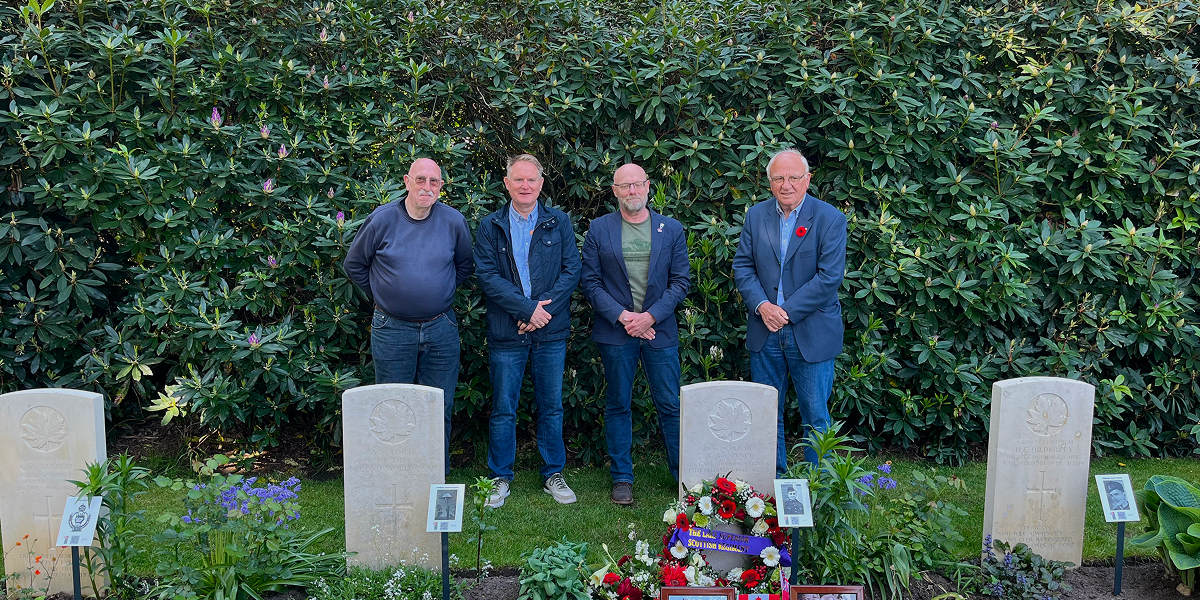
The story of volunteers Wim and Mies Husslage
Curious about what motivates the volunteers who dedicate their time to the information center? Follow their stories. Wim and Mies Husslage share their experiences:
What was your motivation?
We believe that providing information is important. We have lived in Holten since 1972 and have been visiting the Canadian War Cemetery ever since. The information available in the shelters at the cemetery regarding the role of Canadian troops in our liberation is limited.
When and how did you get involved with the information center?
When we read in the Holtens Nieuwsblad that 'the Afsluiters' were planning to build an information center, we immediately offered our help. Initially, in 2008, Mies was asked to assist as an English teacher at the Waerdenborch. She provided the English translation for the 'bid book' required for a grant application. It turned out to be a massive operation to bring those plans to life. All credit goes to those 'founding fathers' who persevered with their vision.
What does your work involve?
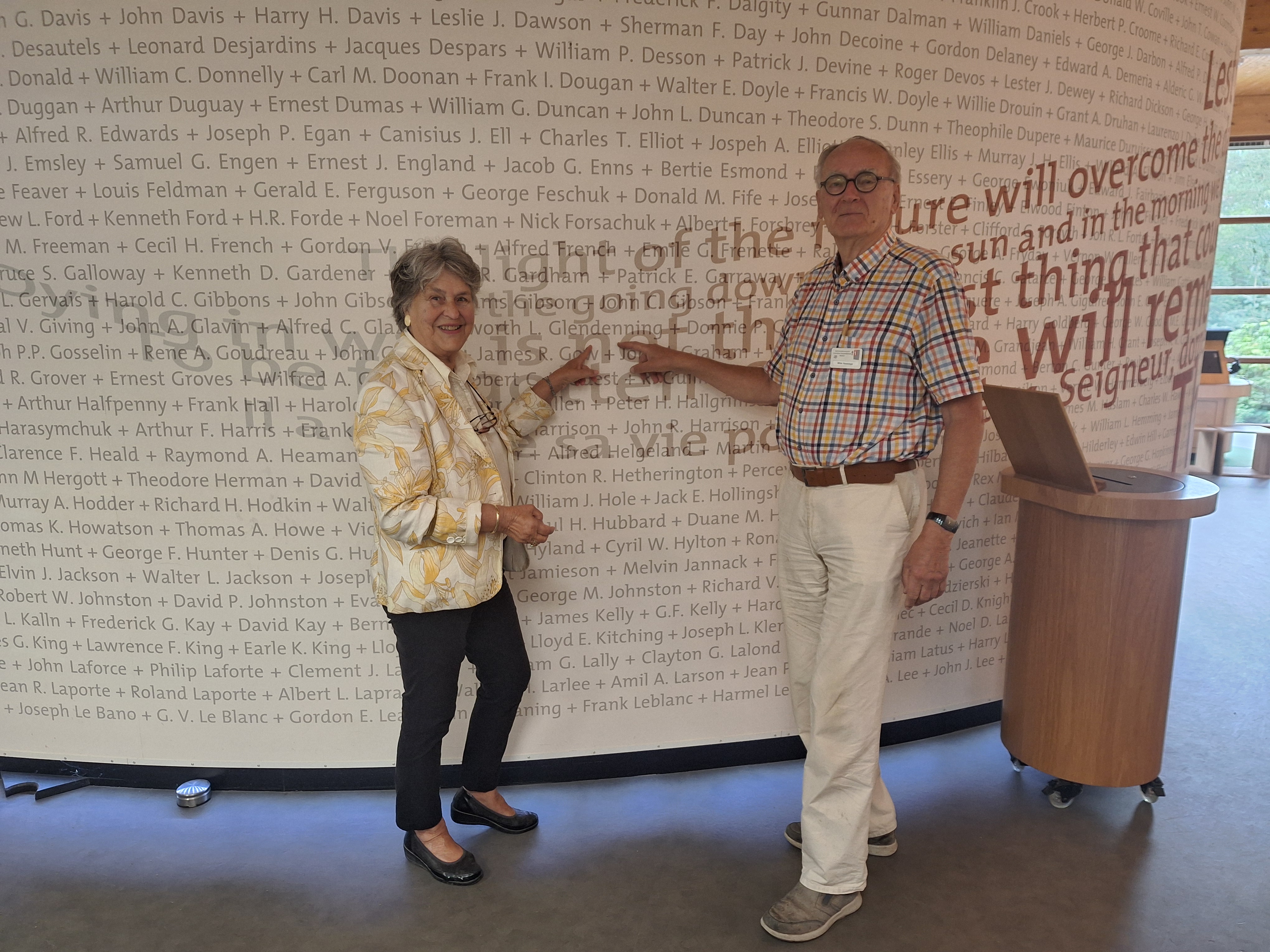
Once the building was completed, we immediately started serving as hosts. We decided to take a Wednesday shift together every month. The day consists of opening up, cleaning, welcoming visitors, explaining the route, walking around to provide clarification, and, of course, tidying up and closing. The day is never boring: every interaction is new and interesting.
What makes you so committed?
We have felt a special connection to the cemetery since 1985. On May 4th of that year, our then 11-year-old daughter, Willemijn, recited a poem at the commemoration. In English. She was in a class taught by Gert Jan van ‘t Holt—one of the later Afsluiters. He had asked Mies to translate a Dutch poem into English. The veterans present were deeply moved by Willemijn’s performance. One of them wrote a letter to the then-mayor, Van Rappard, asking if he could correspond with the girl. That was the beginning of a correspondence with Canada that continues to this day. The veteran belonged to the Seaforth Highlanders regiment. We have visited him and his American wife in Canada several times.
How did you come into contact with a descendant of a Canadian victim?
During the liberation of Eastern and Central Netherlands, the Canadian Seaforth Highlanders came into contact with a number of Dutch students who were in hiding. They reported to the troops and were immediately deployed as translators, even receiving military rank. These connections continued through the Pipes and Drums band of the Seaforth Highlanders of Holland, which organizes the Memorial Sunday at the cemetery every November.
The Seaforth Regiment was deployed during the crossing of the IJssel in April 1945. Their Major, Haworth Glendinning, lost his life during that operation. He had been with the regiment since 1943, had earned a distinguished service record in battles in Sicily and Italy, and was killed during Operation Canonshot. He had married in England just the week before. His comrades were devastated. “It was actually a silly accident,” veteran Dave Harper told us. “Because he had just returned from his wedding leave, we kept him peripherally involved in the operation, and he was one of the last to cross the river. Suddenly, he stood up in the boat, took a direct hit, and fell. He had so much experience; we didn't understand it and were heartbroken.” He is buried at the cemetery in Holten.
It must have been ten years ago that we received a late Saturday afternoon call from a hostess at the information center, Carin van Avesaat. She had hosted someone who claimed to be the 'daughter of Glendinning.' “We knew more about this Major, didn't we? Did he actually have a daughter?” We rushed to the cemetery, but saw no one who could be 'the daughter.' At the grave, there was a plant with a heart in it. No note in the guestbook. Nothing. It wouldn't leave our minds.
By pure coincidence (or does coincidence exist?), an English couple visited during our shift a year later. They had watched the film, visibly moved. When we asked why they were so involved, they said they had just visited their uncle's grave. It turned out to be… Glendinning! We told them the story about a possible daughter. They were stunned. “No, Uncle had no descendants!” Contact with his uncle's wife had been lost, but they were certain that 'Uncle and Aunt' had no children together. They urgently asked us to try and uncover the identity of the potential daughter.
We had been told that this daughter spoke Dutch and that her Dutch mother had said she was the child of a Canadian named Glendinning. Furthermore, a photo of Glendinning showed a striking resemblance to his grandson. We pulled out all the stops to find the daughter. Unfortunately, with no result.
What has made a deep impression on you during this entire period?
Seven years ago, on a Monday, the expansion of the information center began. We were called and asked why we weren't there yet. On a Monday? We always work on Wednesdays, don't we? We rushed to the information center to relieve the guard. It wasn't busy. Two ladies walked in. One lady was gasping for air and having trouble walking. We got a chair and a glass of water and asked what was wrong. She had visited her father's grave. His name was Glendinning! The daughter we had been searching for for years was suddenly standing right in front of us. Emotionally, she told her story that afternoon. Regien Klein Hegeman, who was reporting on the expansion of the information center for De Stentor, was there as well.
Late in the afternoon, we arranged to meet the following day. Unfortunately, she cancelled. It became too much for her emotionally. She wanted to visit her father Glendinning's grave, but decided against meeting the English family. The family regretted her decision but respected it. Later that year, a fire broke out at the English Glendinnings' home. They managed to escape with their lives, but everything was lost, including their uncle's high-ranking DSO medal and decorations. Ashes to ashes, dust to dust.
What do you get out of this volunteer work?
Every encounter here is memorable to us, but the one we just described is truly special.
Why should people visit the information center?
It is always a joy for us to explain to visitors how the liberation of Northern and Eastern Netherlands unfolded. We notice that the current uncertain and tense global situation prompts every visitor to realize that our freedom can never be taken for granted. The layout of the information center, with all the available information, the guided tours, and the welcome from our dedicated hosts, contributes all the more to this.
For us personally, it is deeply satisfying to share our story. A warm friendship grew out of the correspondence our 11-year-old daughter had with Canadian veterans in 1985. It went so far that one of them stipulated in his will that Willemijn's two daughters should receive a necklace in his memory on their eighteenth birthday.
The impressive story of the Canadians who were willing to give their lives for our freedom is beautifully highlighted, cherished, and passed on in the Information Center. Lest we forget!
Read more news here
Discover the unforgettable stories of Canadian liberators.
.jpeg)