

The story of volunteer Edwin van der Wolf
“I think it's important to make people aware of the value of freedom and the importance of democracy”.
The story of volunteer Edwin van der Wolf
“I think it's important to make people aware of the value of freedom and the importance of democracy”.
.avif)
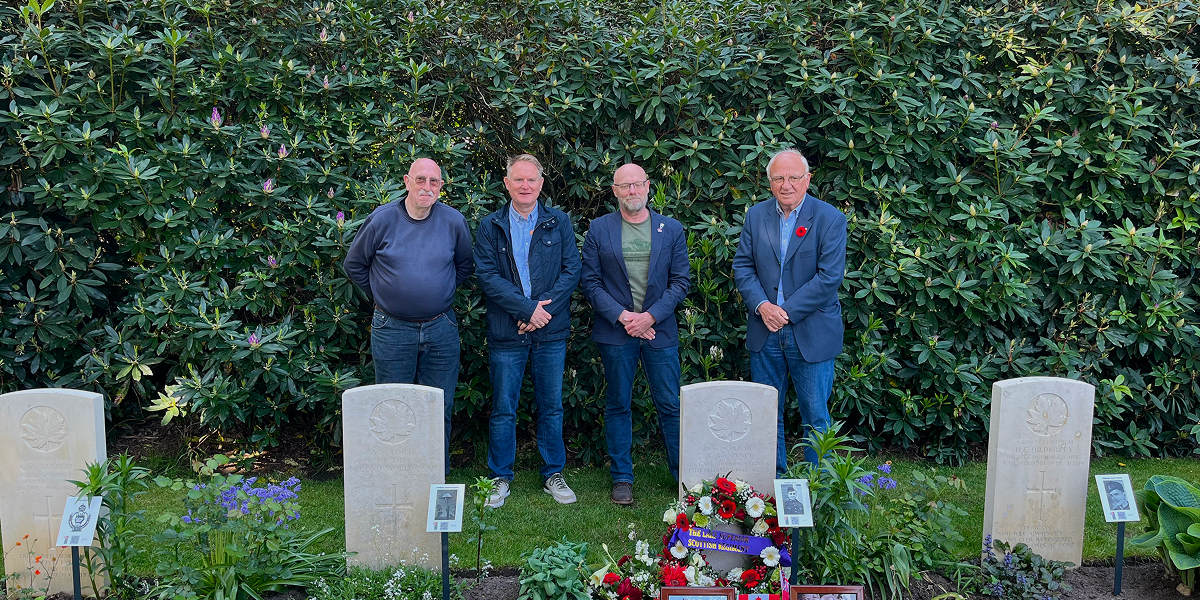
The story of volunteer Edwin van der Wolf
Curious about what motivates volunteers who work for the information center? Edwin van der Wolf explains:
“I think it's important to make people aware of the value of freedom and the importance of democracy”.
When and how did you get involved with the information center?
In 2011, I received a letter asking for financial support for the information center to be set up. I gave that support and I signed up as a volunteer. My grandfather was decisive. Time and again, he told me about the liberation of the Voorstad district in Deventer from Schalkaar on April 10, 1945 by Canadians. Later, I found a photo with an English tank, the English fighting alongside the Canadians, right in front of his home.
What are you working on?
Immediately after the opening of the information center, I started as a host, every other week on Sunday afternoon with colleague Ab Waak op Reijers. Shortly thereafter, I also went on tours and I am a member of our research team that is constantly looking for and researching information about the liberation and life stories of the 1,394 soldiers who are buried on the field. I have a very special affinity for the stories of 18 fallen First Nations (native inhabitants of Canada) and 6 Métis (people with a mix of French and Indian blood). A forgotten group, I think.
What is your biggest challenge and motivation?
I find it a challenge to show visitors the gigantic sacrifices that Canadian soldiers and their families made to rid us of the very cruel regime of the ruthless German occupiers. In principle, I am in favour of democracy and against all forms of fascism.
Can you take us to a goosebumps moment?
As part of the liberation of Wierden, a group of Canadian students visited our information center. During the tour of the cemetery, a student stopped at a grave to share the life story of the fallen soldier with the group. The soldier had been an avid smoker. The student lit a cigarette and placed it in the earth while burning. He played a pop song from that time on his mobile phone. At the next grave, a student left a box of Canadian souvenirs. At the third grave that received special attention that day, a lecturer told the life story of the soldier who immigrated from Scotland to Canada, after which she performed a typical Scottish martial dance to music. All very special and moving.
What does the research work give you?
I think it's an honorable thing to do. Since 2005, we celebrated 60 years of liberating my former hometown of Hattem, I have been in very good contact with the Canadian Scottish Regiment (CSR). Since landing in Normandy on June 6, 1944, while advancing through Northwestern Europe, around 400 soldiers. In 2020, in honor of and respect for these heroes, I had a website built with their life stories, which I researched myself. A number are buried in Holten and a number in Groesbeek. In 2018, I was the only one outside Canada to receive the regiment's Jack Fawcett Award for my research work. In 2019, the Canadian Ambassador personally awarded me the Sovereign's Medal for Volunteers for my efforts at the Information Center.
Why do people need to visit the information center?
To make us aware of the value of freedom and the importance of democracy. Democracy is also under pressure today and it is important to work together across borders and to combat polarization.
Read more news here
Discover the unforgettable stories of Canadian liberators.
.jpeg)