

Seventy-five years of liberation in the Netherlands - reflections from a Canadian soldier
As we approach National Remembrance Day and Liberation Day in the Netherlands on May 4th and 5th respectively, we see humanity embroiled in another global struggle: the fight against COVID-19.
Seventy-five years of liberation in the Netherlands - reflections from a Canadian soldier
As we approach National Remembrance Day and Liberation Day in the Netherlands on May 4th and 5th respectively, we see humanity embroiled in another global struggle: the fight against COVID-19.
As we get closer to the National Remembrance Day and Liberation Day in the Netherlands on May 4 and 5, respectively, we see that humanity is involved in another global battle; the fight against COVID-19. For that reason, while we are all doing our part to defeat this terrible virus, we will continue to reverently remember the victims of the war and celebrate the 75th Liberation Day of the Netherlands in a way that no one knew just weeks ago. could still have imagined. Canada has a long and very close relationship with the Netherlands. The severe coronavirus attack has led to the delay of nearly 80 of the more than 140 memorial events that would be supported by Canada during the 75th anniversary. It also affected 33 Canadian groups that planned to participate in these celebrations. As we take the time to reflect on Dutch Remembrance and Liberation Day this month of May, on behalf of all Canadians, I would like to thank the Netherlands for continuing to honor and respect the fallen Canadian soldiers, marines and airmen. You are the guardians of the Canadian war dead.
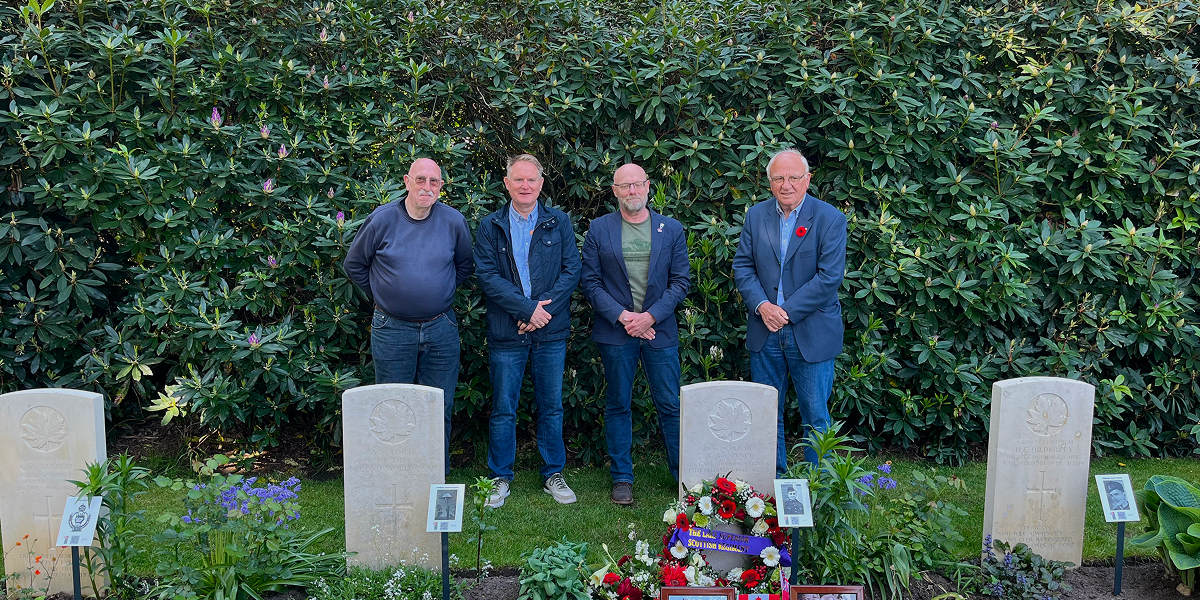
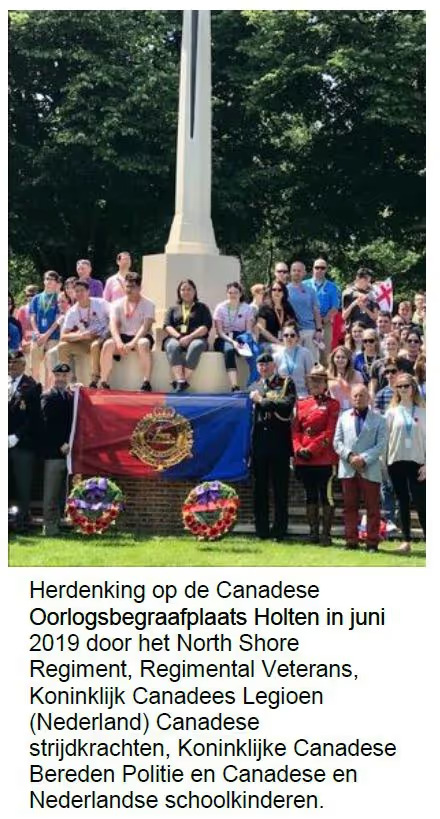
5712 members of the Canadian armed forces are buried in 199 cemeteries in the Netherlands. 55 of them are from First Nation, Canada's indigenous population, and 14 are from Newfoundland. The large majority of these men are buried in three Commonwealth War Cemeteries in Bergen op Zoom, Holten and Groesbeek. The other 196 cemeteries are spread across the country, among the locals. Here are mainly pilots who were brought to their final resting place near where their plane crashed. For the average Canadian, the customized way in which the Dutch honor our war dead is very impressive. The entire people are involved in the memorial activities in one way or another, in one way or another.
It is simply impossible to name every Dutch group or activity involved in commemorating Canada's participation in the liberation of the Netherlands. Nevertheless, the ingenuity of the Dutch community, the guardians of our fallen, in recognizing the Canadians' sacrifice for their freedom is nothing short of amazing. The scope of activities varies from national organizations to smaller, local groups that specifically focus on specific events that take place in their own communities. There are festivals, museums, marching bands, re-enactors, commemorative events and multiple imaginative projects. This involves families and individuals in a certain capacity. Whether that's supporting a Canadian veteran in their home when they come to visit their dead comrades, attend a memorial service, children lay flowers on graves, or put a candle on the grave on Christmas Eve, there is a way for everyone to participate. Even during the world-famous Four Days Marches in Nijmegen, the fallen of Canada and other countries are honored. In short, at every level, from families to the National Committee on 4 and 5 May.
All Dutch people are deeply aware of the value of freedom. Freedom is one of the cornerstones that define the national identity of both Canada and the Netherlands. In fact, freedom is so important to the identity of both countries that it is mentioned in both national anthems, the “Oh Canada” and the “Wilhelmus,” which also appears to be the oldest national anthem. However, there is a difference in how freedom is viewed in both countries. This is visible in how the Dutch celebrate and commemorate freedom, and that is why Canadians go to the Netherlands to participate in these events. To be clearer, since the Confederation was formed in 1867, Canada has not been directly threatened in its sovereignty in a way similar to the situation of the Netherlands during the Second World War. Canadians have never had to face immediate hardship and destruction to regain freedom on Canadian soil. In fact, Canada has always supported the fight against tyranny by sending its armed forces to other countries. Therefore, in order to fully understand the value of freedom and the struggle and sacrifice to regain it, Canadians are going to Europe and other distant countries. They come to the Netherlands specifically to talk to people, to walk across the war fields and to see the graves of Canadian soldiers with their own eyes to understand the destructive power that the Second World War had in preserving freedom. This important point is ingrained in Dutch culture and whether it's attending a memorial or a festival, the impact of the war has really affected the Dutch to this day: freedom will never be taken for granted.
Recently, the number of veterans and civilians who experienced the dangers of the Second World War and who have shared its hard lessons has begun to decline. People are thinking about how the liberation of the Netherlands will be remembered when they are gone. Veterans themselves may best describe it with the lyrics to a Bing Crosby song, “Old soldiers never die, they just fade away”, or “Old soldiers don't die, they only disappear gradually.” Veterans of the Second World War are being replaced by younger generations who all served in the same regiments as their ancestors. Countless groups of these veterans were ready to come to the Netherlands this May, they too are coming to be reminded of the impact of the war and to honor their brothers in arms.
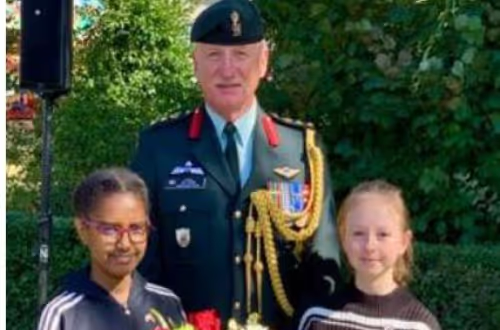
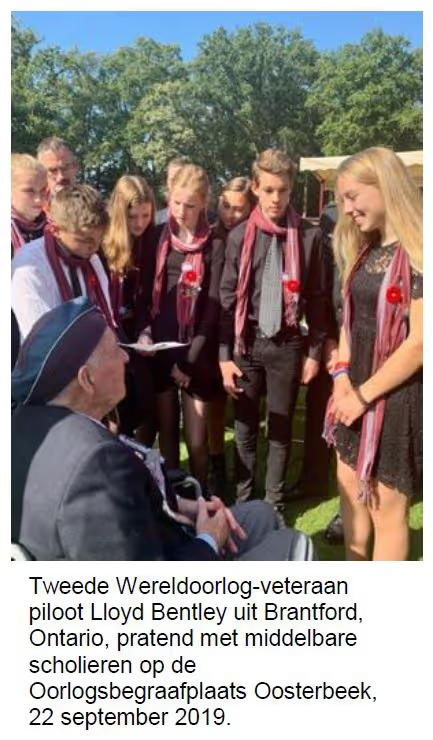
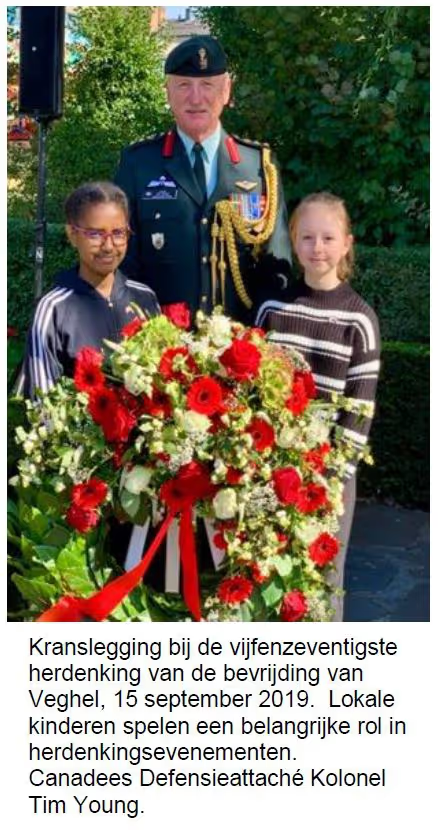
While veterans are the catalyst for commemoration, the future is actually in the hands of our younger generations. The strength of youth should not be underestimated: Dutch secondary school students have led memorial meetings in the Canadian cemeteries for the Canadian high school students who came to visit. As a result, the hard lessons of the war were not lost among Dutch youth. It's really inspiring to see them share their idea of freedom with their foreign friends. Before the effects of COVID-19 led to the delay of this year's celebrations, more than 2,200 Canadian school children were planning to attend the memorial and liberation ceremonies this spring.
While every memorial service honoring the Canadian veterans of the Second World War is invariably attended by members of the Royal Netherlands Air Force, the Canadian Armed Forces also honor Dutch soldiers who lost their lives serving their country. For example, every year on 4 May, the Canadian armed forces participate in the memorial parade at the Remembrance Square—The Obelisk at Soesterberg Air Base of the Royal Dutch Air Force. During this parade, a special tribute will be given to all Dutch pilots who lost their lives in the previous calendar year. The Canadian Armed Forces also pay tribute to the Dutch resistance to the Second World War at the commemoration of The Prince Bernhard Shock Troops Regiment. This unique infantry regiment was formed in 1944 by Prince Bernhard from a group of resistance fighters. At a joint memorial in Hoogkerk, the two Canadian Infantrymen who died during the Battle of Groningen, the crew of an allied Lancaster Bomber, and Corporal Kevin Roggeveld were commemorated by both nations. Corporal Kevin Roggeveld was a Dutch soldier from the 13th Infantry Battalion of 11 Airmobile Brigade of the Royal Army. He died in 2016 while on a mission in Mali. Finally, Canada, along with many other countries that make up the diplomatic community in the Netherlands, attends commemorative events held by other countries to pay tribute to the soldiers who lost their lives serving their nation.
The Canadian embassy had plans to support more than one hundred and forty events throughout the 75th anniversary, which were grouped into clusters with multiple ceremonies on the same day across the country. To support this valuable enterprise, an entire embassy approach was needed, consisting of members of the Canadian Armed Forces, the Royal Canadian Mounted Police, the Canada Border Services Agency, Global Affairs Canada, other Canadian diplomats and local Dutch employees of the Canadian government. As staff of the Canadian embassy, we are deeply moved and immensely proud that the Dutch employees of our team were very willing to volunteer to represent Canada at some of these events, reaffirming their commitment to the commemoration.
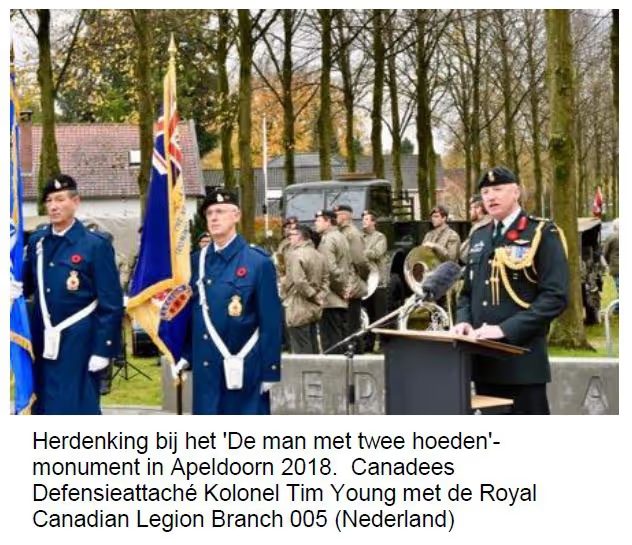
As a Canadian soldier and veteran who served in the Netherlands, it is really special to see the extent of the effort that has been made to honor the Canadian fallen. It was remarkable and something to be thankful for: seeing the countless Canadian flags lining the streets that marked the day a city or village was liberated, such as Apeldoorn; watching the Royal Canadian Legion (Dutch Branch 005) proudly support a local memorial with a flag guard; reading a profile of a Canadian soldier buried at Groesbeek Military Cemetery, written by a Faces-to-Graves volunteer; a convoy of recovered military vehicles with their 'Keep-Them- reenactors Seeing “Rolling” enter a memorial site; listening to a Dutch volunteer talk about Canadian soldiers buried at Holten Military Cemetery; seeing an entire community come together to tell about the tragic fate of an aircraft such as the Halifax Bomber L9561 in Wons; working with a local community to identify a missing Canadian soldier like Lieutenant John G. Kavanagh in Steenderen. During the final scene of the play Supersum in Bergen op Zoom, we are proud to sing along to Canada's national anthem with hundreds of locals. It is clear that 75 years later, the loss of those 5712 Canadian soldiers, marines and aviators was not in vain.
This year, the COVID-19 pandemic has created a new reality around the commemorations and celebrations on 4 and 5 May, but this has not discouraged the Dutch. They do not admit that their 75th anniversary cannot take place and have, in fact, already started converting this year's plans to “75 + 1 liberation”. The pandemic will not discourage Canadians in the same way, because we are also looking forward to be there next year, together with our Dutch friends.
Lest we forget - N'oublions jamais - Lest we forget.
Tim R. Young
Colonel
Canadian Defence Attaché - Netherlands

Read more news here
Discover the unforgettable stories of Canadian liberators.
.jpeg)